El Capricho de Gaudí is an 1885 Art Nouveau villa in Comillas, one of only three Gaudí works you can visit outside Catalonia. You explore it freely, inside and out, with no time limit, for a general admission of €7. In September it opens from 10:30am to 8pm and it's about a 45-minute drive from Bareyo.
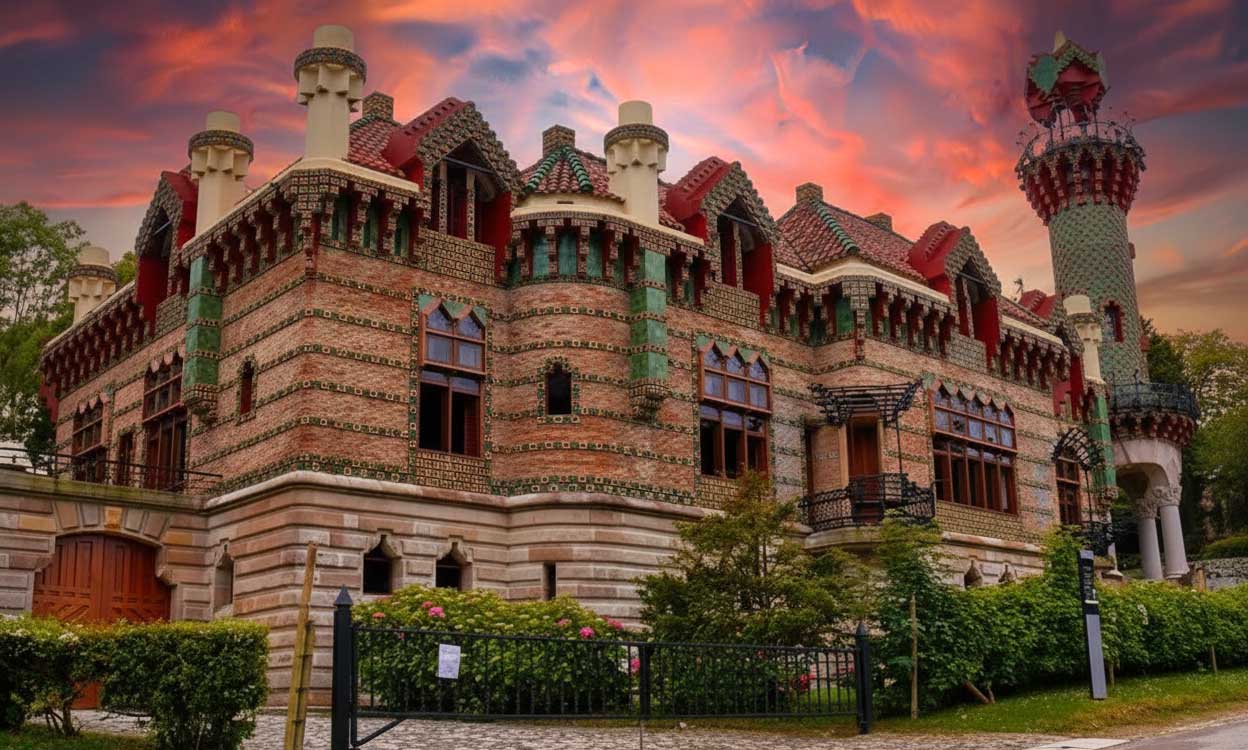
It's hard to picture Gaudí working outside Barcelona, but in Comillas he left behind one of his most singular creations even before starting the Sagrada Familia. It was commissioned by Máximo Díaz de Quijano, an "indiano" who'd made his fortune in Cuba, as a summer home close to the circle of the Marquises of Comillas, who at the time were turning the village into the aristocracy's summer retreat — and even a haunt of Alfonso XII's court. Gaudí, barely thirty at the time, never actually set foot on the building site: he directed the work by letter and through an assistant.

The result is a house that's much smaller and more playful than his Barcelona buildings, designed to be experienced on a human scale. The visit takes about 45 minutes, with no guided tour required, and it's part of the monumental Sobrellano complex, alongside the Palacio de Sobrellano and the family's Capilla Panteón.
Gaudí's El Capricho: a summer villa in the Sobrellano district
The building went up between 1883 and 1885 as a summer residence, on land given over by the Marquis of Comillas himself, right next to his palace. Comillas was then at its peak as a summer destination in the north, and Díaz de Quijano's villa was designed to match that setting without competing in size with the neighbouring palace. Today it still stands on the same spot, surrounded by gardens, and it's easy to visit it together with the rest of the Sobrellano complex in the same afternoon.
The sunflower-tile façade that made it one of a kind
The first thing that catches your eye is the façade: horizontal bands of ceramic tile with raised sunflower motifs, alternating with exposed brick, wrapping around almost the entire building. The floral decoration and warm tones echo the orientalist, colonial taste that Díaz de Quijano brought back from Cuba, something quite unusual in Cantabrian architecture of the time. A corner watchtower, originally conceived as an observatory, crowns the building and offers the best views of the garden from inside the house itself.

Inside: wood, iron and a very Gaudí kind of logic
Inside, the exposed wooden structure and the iron columns shaped like plant stems already hint at devices Gaudí would go on to perfect in Barcelona. The rooms were laid out according to the sun's path, with daytime rooms facing east and south, and legend has it that Gaudí himself built a small optical instrument to study the sun's course before fixing the exact orientation of each window. The façade, too, has its own internal logic that isn't obvious at first glance: the sequence of tile and brick follows a regular rhythm that some scholars link to Díaz de Quijano's love of music. The visit includes audiovisual content and information panels explaining these details, which are easy to miss at a glance.

How to get there from Bareyo
You get there via the A-8, taking exit 249, signposted jointly as Comillas and Cabezón de la Sal, and from there it's a few minutes on local roads to the Barrio de Sobrellano. As a more scenic alternative, the CA-131 runs along the coast between San Vicente de la Barquera and Suances, passing through Comillas itself, though it takes a bit longer. From Bareyo it's about a 45-minute drive on the A-8, and since the villa sits right at the edge of town, you can park and then continue on foot to the historic centre or the seafront promenade.
What you need to know
General admission is €7, with discounts for over-65s, students, large families and the unemployed; the visit is self-guided and has no time limit. In September and October the opening hours are 10:30am to 8pm, with last entry half an hour before closing; hours change in winter and during peak season, so it's worth checking the official website before you go. It's located in the Barrio de Sobrellano, s/n, in Comillas, with parking nearby. It combines easily with the Palacio de Sobrellano and the Capilla Panteón, just a short walk from the villa itself, and with Comillas' historic centre — all the official information on the monument is available on the Cantabria Tourism page.
Before the Sagrada Familia, before Park Güell, Gaudí was already playing with ceramics, light and plant-like forms here, in a summer villa that almost nobody paid attention to for decades.
El Capricho works well as a morning stop on a longer route along the western coast, and if you're heading that way, our guide to the beaches of Cantabria's western coast lists other stops near Comillas worth adding to the plan. If you're staying at Bareyo Residences, the drive to Comillas on the A-8 is direct and largely traffic-free outside summer peak hours, so it's easy to get there mid-morning and carry on after lunch. If you're already thinking about a quieter stay, September 2027 is starting to open up on our calendar.